



Remnant 2 archetypes determine how your character fights, survives and supports teammates throughout the game. There are 14 archetypes available, each offering unique skills, perks and combat advantages. These classes include powerful damage dealers, defensive fighters, healers and specialised summoners. However, you are not limited to one playstyle. The dual-archetype system allows you to combine two classes and create a character that suits your preferred approach to combat.
Whether you enjoy dealing massive damage, keeping teammates alive or controlling enemies with special abilities, choosing the right archetypes can make a significant difference. Understanding their strengths also helps you create stronger builds for difficult bosses and challenging adventures.
Complete Guide to Remnant 2 Archetypes
Archetypes are essentially character classes in Remnant 2. Each one has its own abilities, passive bonuses and unique combat identity. Your starting choice determines your initial equipment and playstyle, but you can unlock additional classes as you progress.
Every archetype features three active skills and five perks. It also has a unique trait that improves particular character attributes. These abilities develop as you earn experience and increase your archetype level.
The maximum level for an archetype is 10. Reaching this level unlocks its unique trait for use without equipping that particular class.
The most interesting feature is the ability to equip two archetypes simultaneously. This creates opportunities for specialised builds that combine offensive and defensive abilities.
All 14 Remnant 2 Archetypes Explained
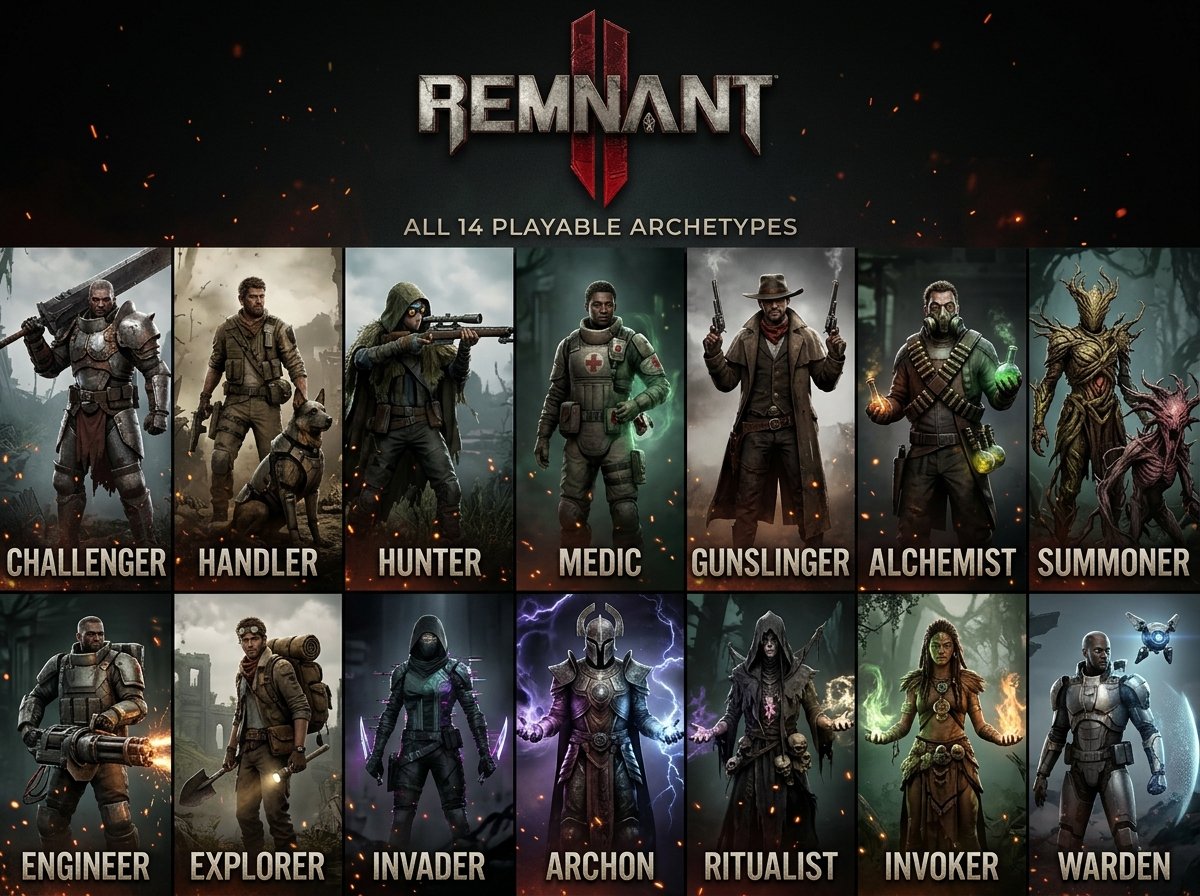
Remnant 2 features 14 playable archetypes across the base game and its downloadable content. Each class offers a different approach to combat.
1. Challenger
Challenger is designed for players who prefer close-range combat and aggressive fighting. This archetype focuses on durability, powerful attacks and surviving dangerous encounters.
Its abilities help players fight multiple enemies without constantly retreating. Challenger also provides useful defensive advantages, making it a suitable choice for beginners who enjoy direct combat.
Its prime perk, Die Hard, provides a survival advantage when taking otherwise fatal damage. This makes Challenger particularly useful during difficult encounters.
2. Handler
Handler is one of the most versatile archetypes in Remnant 2. Its biggest advantage is a loyal dog companion that supports the player during combat.
The dog can attack enemies, distract threats and provide valuable assistance. Depending on the selected skill, it can also help restore health or revive its owner.
Handler is particularly useful for solo players because the companion provides additional support without requiring another human teammate.
Its prime perk, Bonded, allows the dog to revive the player under suitable conditions.
3. Hunter
Hunter specialises in ranged combat, precision shooting and weakspot damage. It is an excellent choice for players who prefer eliminating enemies before they get close.
Its abilities improve weapon performance and help identify targets during combat. Hunter also rewards accurate aiming and careful positioning.
This archetype works especially well with powerful rifles and other long-range weapons. Players who enjoy landing critical hits will find plenty of value in its abilities.
Its prime perk, Dead to Rights, extends skill duration when dealing sufficient ranged damage.
4. Medic
Medic is a support-focused archetype that specialises in healing and keeping players alive. It is particularly valuable during difficult boss encounters and multiplayer adventures.
Its skills provide healing opportunities, protective support and additional survivability. Medic can also help teammates recover during intense battles.
Although it focuses on support, this class is not limited to defensive gameplay. Combining Medic with a damage-focused secondary archetype can produce a balanced character.
Its prime perk, Regenerator, rewards healing by restoring relic charges.
5. Gunslinger
Gunslinger focuses on firearms, ammunition management and fast-paced shooting. It is particularly effective for players who want to maximise weapon damage.
Its abilities improve reload speed, ammunition efficiency and overall shooting performance. These advantages make it a strong option for aggressive ranged builds.
Gunslinger also works well alongside Hunter, creating a combination focused on precision and sustained weapon damage.
Its prime perk, Loaded, helps restore ammunition and improve combat efficiency.
6. Alchemist
Alchemist is a specialised support archetype that uses powerful concoctions to improve combat performance.
Its abilities provide temporary bonuses that can improve survivability and offensive effectiveness. This makes it useful for players who enjoy supporting their builds through additional buffs.
Alchemist can complement several different classes, especially those focused on weapon damage or team support.
Its prime perk, Spirited, provides additional opportunities to benefit from concoctions.
7. Summoner
Summoner focuses on creating additional allies through powerful creatures. These summoned companions attack enemies and provide extra assistance during combat.
Its abilities allow players to summon different creatures with specialised combat roles. This creates an alternative playstyle where companions contribute significantly to overall damage.
Summoner is particularly interesting for players who prefer controlling the battlefield rather than relying entirely on direct weapon attacks.
Its prime perk, Ruthless, improves damage when summoned creatures are active and engaged in combat.
8. Engineer
Engineer is built around heavy weapons, powerful turrets and defensive battlefield control.
Its abilities allow players to deploy heavy weapons that can automatically attack enemies or be operated directly. These tools provide additional firepower during difficult encounters.
Engineer is particularly useful when fighting groups of enemies or defending a position. Its heavy weapon mechanics also make it an interesting choice for players who enjoy technical combat.
Its prime perk, High Tech, enhances heavy weapon capabilities.
9. Explorer
Explorer is focused on exploration, resource collection and discovering valuable items.
Rather than concentrating entirely on combat, this archetype provides useful advantages when searching different environments. Its abilities help players discover valuable resources and improve their overall exploration experience.
Explorer is especially useful for players who enjoy collecting equipment and searching every corner of the game’s environments.
Its prime perk, Lucky, improves the chances of finding additional valuable items from defeated enemies.
10. Invader
Invader is designed around mobility, evasion and confusing enemies during combat.
Its abilities help players avoid attacks, reposition quickly and create opportunities to strike opponents. This makes it particularly effective for players who prefer fast and tactical gameplay.
Invader can also complement damage-focused archetypes by providing additional defensive options.
Its prime perk, Shadow, creates opportunities for enemies to target decoys instead of the player.
11. Archon
Archon is a specialised archetype focused on weapon modifications, skill interactions and generating mod power.
It is particularly useful for builds that depend heavily on weapon mods and special abilities. Its skills provide additional opportunities to use powerful effects during combat.
Archon can create interesting combinations with other archetypes, especially those that already rely on frequent ability usage.
Its prime perk, Tempest, improves mod power generation and supports mod-focused builds.
12. Ritualist
Ritualist specialises in status effects and damage that spreads between enemies.
Its abilities are particularly effective against groups because negative effects can weaken multiple opponents simultaneously. This makes it an attractive choice for players who enjoy damage-over-time strategies.
Ritualist can also work alongside other damage-focused archetypes to create powerful combinations.
Its prime perk, Vile, increases the effectiveness of status-effect damage and spreads harmful effects to nearby enemies.
13. Invoker
Invoker is an ability-focused archetype introduced through The Forgotten Kingdom DLC.
It specialises in powerful skills and elemental abilities. Its mechanics make it particularly useful for players who prefer using archetype skills rather than depending entirely on firearms.
Invoker also provides additional skill charges, creating more opportunities to use abilities during combat.
Its prime perk, Visionary, increases skill charges and improves skill-based gameplay.
14. Warden
Warden arrived with The Dark Horizon DLC and focuses on defensive support and technological assistance.
Its abilities provide additional protection and utility through specialised equipment, including its drone. This makes it a useful option for players who want a balance between survival and combat effectiveness.
Warden can support different team compositions and works particularly well with archetypes that benefit from additional protection.
Its prime perk, Dynamic, provides defensive benefits through its shield-focused mechanics.
How to Unlock More Archetypes in Remnant 2
You begin your adventure with four standard starting choices: Challenger, Handler, Hunter and Medic.
However, the remaining archetypes become available through exploration, progression and special activities.
Most unlock methods involve discovering a unique item associated with a particular archetype. You then take that item to Wallace in Ward 13, where he can transform it into an equippable Engram.
Some archetypes require additional steps. For example, Summoner involves collecting Blood Moon Essence in Yaesha, while Engineer requires finding a hidden Alien Device in N’Erud.
Other classes involve more complicated discoveries. Archon requires several specific equipment pieces, abilities and progression requirements. Invader also involves a special encounter on Root Earth.
DLC archetypes require access to their respective downloadable content and associated locations.
Once you unlock an archetype, you can equip it on your character and begin developing its abilities.
How the Dual Archetype System Works
One of the biggest advantages of Remnant 2 is its dual-archetype system.
After collecting 10 Trait Points, you unlock the ability to equip a secondary archetype. This allows you to combine two different classes and benefit from their abilities.
Your primary archetype provides its Prime Perk, while your secondary archetype provides its other available perks and skills without its Prime Perk.
For example, combining Handler and Hunter creates a character with companion support and improved ranged combat capabilities.
Similarly, Medic and Challenger offer a balance between healing and close-range survivability.
You can experiment with different combinations to discover which abilities complement your preferred weapons and combat strategy.
What Is the Best Archetype in Remnant 2?
There is no single best archetype for every situation. Your ideal choice depends on whether you prioritise damage, survival, exploration or team support.
Handler is an excellent option for beginners and solo players because its dog companion provides valuable assistance.
Hunter is a strong choice for precision-focused players who enjoy ranged combat. Meanwhile, Gunslinger suits players who prefer fast shooting and powerful firearms.
Medic is particularly useful for cooperative gameplay, while Engineer offers additional firepower through heavy weapons.
Ritualist is worth considering for players who enjoy status effects and damage-over-time strategies. Invoker is another strong option for ability-focused builds.
Ultimately, the best approach is to experiment with different primary and secondary combinations. Your equipment, accessories and preferred combat style also influence how effective a build becomes.
Conclusion
Remnant 2 archetypes provide an extensive range of combat options, allowing players to develop characters around their preferred playstyles. With 14 available classes, there are plenty of opportunities to experiment with different skills, perks and abilities.
Whether you prefer Handler’s loyal companion, Hunter’s precision shooting, Medic’s healing abilities or Engineer’s heavy weapons, every archetype offers something valuable.
The dual-archetype system makes character customisation even more interesting. By combining two complementary classes, you can create specialised builds for solo adventures, cooperative battles and challenging boss encounters.
Understanding each archetype is the first step towards finding the combination that works best for your journey.
FAQs
How many archetypes are there in Remnant 2?
Remnant 2 features 14 archetypes in total. These include 11 archetypes from the base game and three introduced through downloadable content. Each offers different skills, perks and gameplay advantages.
What is the best starting archetype in Remnant 2?
Handler is an excellent starting choice, particularly for beginners and solo players. Its dog companion provides additional damage and support. Medic is another strong option for players who prioritise healing and survival.
Can you use two archetypes at once in Remnant 2?
Yes. Remnant 2 allows players to equip two archetypes simultaneously after unlocking the dual-archetype system. Your primary class provides its Prime Perk, while the secondary class contributes its other available perks and skills.
What is the maximum archetype level in Remnant 2?
The maximum level for each archetype is 10. Reaching this level unlocks its unique trait for use without equipping that archetype. You can then allocate Trait Points to use the unlocked trait.
Which Remnant 2 archetypes are included in the DLC?
The three DLC archetypes are Ritualist, Invoker and Warden. Ritualist comes from The Awakened King, Invoker comes from The Forgotten Kingdom, and Warden comes from The Dark Horizon.
Can you change your archetype after starting the game?
Yes. You are not permanently locked into your original archetype. Once you unlock additional Engrams, you can change your primary and secondary archetypes. This allows you to experiment with different builds without creating a new character.
For more updates visit: RANKIVO