



Planet of the Apes is one of the most recognisable science fiction franchises in cinema. It combines action, adventure, drama, and thought-provoking ideas about humanity. The series has also changed greatly since the original film arrived in 1968.
The franchise explores a world where intelligent apes become a dominant force while humans struggle to survive. Across different films, the story examines freedom, prejudice, leadership, war, family, and the consequences of human actions.
For modern viewers, the franchise can seem confusing because it includes several different eras. The original films, Tim Burton’s 2001 remake, the Caesar trilogy, and Kingdom of the Planet of the Apes all connect to the wider legacy in different ways.
This guide explains the Planet of the Apes story, its major characters, the films, and the best way to watch them.
What Is Planet of the Apes?
Planet of the Apes began with the 1968 science fiction film directed by Franklin J. Schaffner. It was based on Pierre Boulle’s 1963 novel La Planète des singes.
The original story follows astronaut George Taylor after his spacecraft reaches a strange world. He soon discovers that intelligent apes control society while humans have become a primitive population.
The film became famous for its social themes and unexpected ending. It also created a franchise that continued with several sequels.
Over time, the series developed a much larger mythology. Different stories explored how ape civilisation developed and how the relationship between humans and apes changed.
The Original Planet of the Apes Films
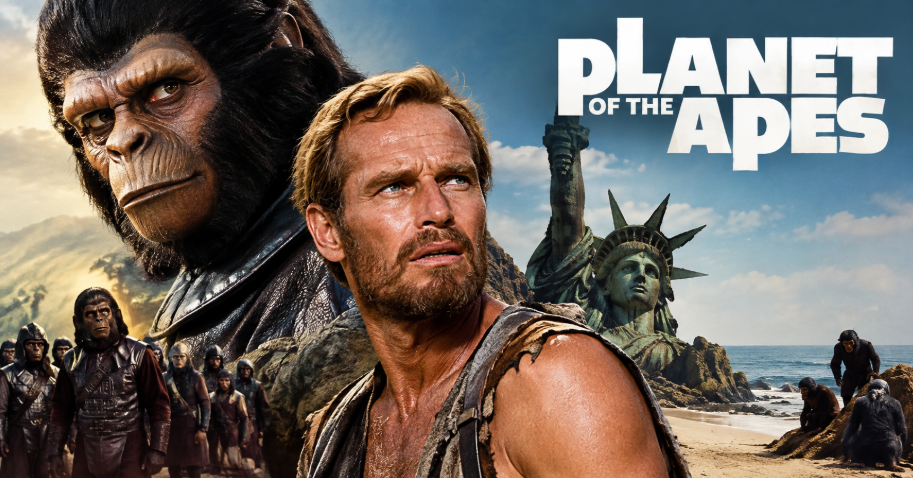
The original film series ran from 1968 to 1973. It includes five main films that build on the events of the first movie.
Planet of the Apes
The 1968 film introduces astronaut Taylor and the mysterious world controlled by intelligent apes. Charlton Heston plays Taylor, whose arrival leads him to question everything he knows about human history.
The film focuses on discovery and mystery. Its ending became one of the most famous moments in science fiction cinema.
Beneath the Planet of the Apes
The 1970 sequel expands the world introduced in the first film. Another astronaut arrives while searching for Taylor.
The story introduces underground human survivors and adds a darker layer to the franchise. It also develops the conflict between different groups living on the planet.
Escape from the Planet of the Apes
The third film changes the direction of the story. Cornelius and Zira travel back to present-day Earth after the events of the previous movies.
Their arrival creates a new problem. Humans become increasingly concerned about what their presence could mean for the future.
Conquest of the Planet of the Apes
Conquest moves further into the origins of the ape uprising. Caesar, an intelligent chimpanzee, becomes central to the story.
The film explores oppression, rebellion, and the treatment of intelligent animals. It also helps explain how the future ape civilisation could develop.
Battle for the Planet of the Apes
The fifth original film explores a society where apes and humans attempt to live together. However, tensions remain between the two groups.
The story focuses more on rebuilding and coexistence than the earlier films. It also brings the original five-film storyline towards its conclusion.
The 2001 Planet of the Apes Film
Tim Burton directed a new Planet of the Apes film in 2001. Mark Wahlberg stars as astronaut Leo Davidson, who lands on a planet controlled by intelligent apes.
The film uses the basic concept of humans living under ape rule but presents a different story from the original series.
Its visual style and production design give the franchise a new look. However, it does not continue the Caesar storyline introduced in the later reboot films.
For that reason, viewers can treat the 2001 movie as a separate interpretation of the franchise.
The Modern Planet of the Apes Trilogy
The franchise returned in 2011 with Rise of the Planet of the Apes. Instead of beginning with an established ape civilisation, the modern series shows how the transformation begins.
Rise of the Planet of the Apes
Rise introduces Caesar, a chimpanzee who develops advanced intelligence after an experimental treatment.
Andy Serkis plays Caesar through performance capture. His relationship with humans becomes central to the story.
The film shows Caesar’s early life and the events that eventually lead apes towards a new future. It provides the foundation for the next two films.
Dawn of the Planet of the Apes
Dawn takes place years after Rise. A virus has devastated human civilisation, while Caesar leads an advanced ape community.
Humans and apes initially try to avoid conflict. However, fear and mistrust slowly push both sides towards violence.
The film gives Caesar a more complex leadership role. He must protect his family and community while trying to prevent another war.
War for the Planet of the Apes
War continues Caesar’s story during a devastating conflict between apes and human survivors.
Caesar faces personal loss and begins a journey driven by justice and survival. The film explores leadership, revenge, compassion, and the cost of war.
It also brings an emotional conclusion to Caesar’s central storyline.
Kingdom of the Planet of the Apes
Kingdom of the Planet of the Apes arrived in 2024 and moves the story several generations beyond Caesar’s reign.
The film introduces a new generation of apes and humans. Caesar remains important to the history of this world, but the story focuses on new characters and conflicts.
Owen Teague plays Noa, a young ape whose journey forces him to question what he has learned about the past. Freya Allan, Kevin Durand, and Peter Macon also star in the film.
Kingdom expands the world established by the Caesar trilogy. It shows how different ape societies have developed and how Caesar’s teachings have been interpreted over time.
The film therefore works as both a continuation and a new starting point for viewers interested in the modern series.
Who Is Caesar?
Caesar is the central character of the modern Planet of the Apes storyline.
He begins life as a chimpanzee with unusually advanced intelligence. His experiences with humans shape his personality and beliefs.
As Caesar grows older, he becomes a leader who wants to protect his family and fellow apes. However, leadership repeatedly forces him to make difficult decisions.
His story is important because it connects personal relationships with the larger history of the ape civilisation.
Caesar is not simply a warrior. He is also a father, community leader, and symbol of a changing world.
Why Is Planet of the Apes So Popular?
The franchise remains popular because it offers more than traditional science fiction action.
Its stories ask questions about human behaviour and social conflict. They also explore what happens when one species gains power over another.
The films frequently examine fear and misunderstanding. Humans often fear the growing intelligence of apes, while apes have their own reasons to distrust humans.
Another major strength is its character-driven storytelling. Caesar’s journey gives the modern films an emotional centre that audiences can follow across multiple generations.
The visual effects have also played an important role. Performance capture allows ape characters to communicate complex emotions while remaining visually convincing.
Planet of the Apes Movies in Watch Order
For someone discovering the modern story, the simplest approach is to watch Rise of the Planet of the Apes first.
Follow it with Dawn of the Planet of the Apes and War for the Planet of the Apes. Then watch Kingdom of the Planet of the Apes.
This order follows the modern storyline and makes Caesar’s development easier to understand.
The original five films can be watched separately as the classic series. The 2001 film is also best viewed as a standalone interpretation rather than as a direct part of the Caesar storyline.
The Main Themes of Planet of the Apes
The franchise repeatedly returns to ideas about power, freedom, identity, and survival.
The relationship between humans and apes is particularly important. Neither side is presented simply as a force without emotions or motivations.
Leadership is another major theme. Caesar’s decisions often affect entire communities, making personal choices part of a much larger struggle.
The films also examine the consequences of scientific experimentation. Human attempts to change biology ultimately create consequences that extend far beyond the original experiments.
These themes help explain why the franchise has remained relevant across several decades.
Conclusion
Planet of the Apes has grown from a single science fiction film into a large cinematic universe.
The original movies established the central concept of an ape-dominated world. The 2001 film offered a separate interpretation, while the modern trilogy created a detailed origin story through Caesar.
Kingdom of the Planet of the Apes then opened another chapter several generations later. Its new characters allow the franchise to explore a changing ape civilisation while keeping Caesar’s legacy alive.
Whether you prefer the classic films or the modern stories, Planet of the Apes offers a mixture of action, emotion, mystery, and social commentary that continues to attract new audiences.
FAQs
What is Planet of the Apes about?
Planet of the Apes is a science fiction franchise about intelligent apes and their changing relationship with humans. Its stories explore survival, conflict, leadership, and the rise of ape civilisation.
How many Planet of the Apes movies are there?
The franchise has five original films, one 2001 remake, three films in the modern Caesar trilogy, and Kingdom of the Planet of the Apes. The films belong to different story eras.
Who is Caesar in Planet of the Apes?
Caesar is the central character of the modern trilogy. He is an intelligent chimpanzee who becomes a major leader of the apes and helps shape their future civilisation.
Is Kingdom of the Planet of the Apes connected to Caesar?
Yes. Kingdom takes place several generations after Caesar’s reign. Caesar remains an important historical figure within the world, although the main story follows new characters.
What should I watch first?
Rise of the Planet of the Apes is the best starting point for the modern storyline. It introduces Caesar and explains the beginning of the events that lead to the later films.
Is the 2001 Planet of the Apes connected to the newer movies?
The 2001 film is a separate interpretation of the franchise. It does not form part of the modern Caesar storyline that begins with Rise of the Planet of the Apes.
For more updates visit: RANKIVO