


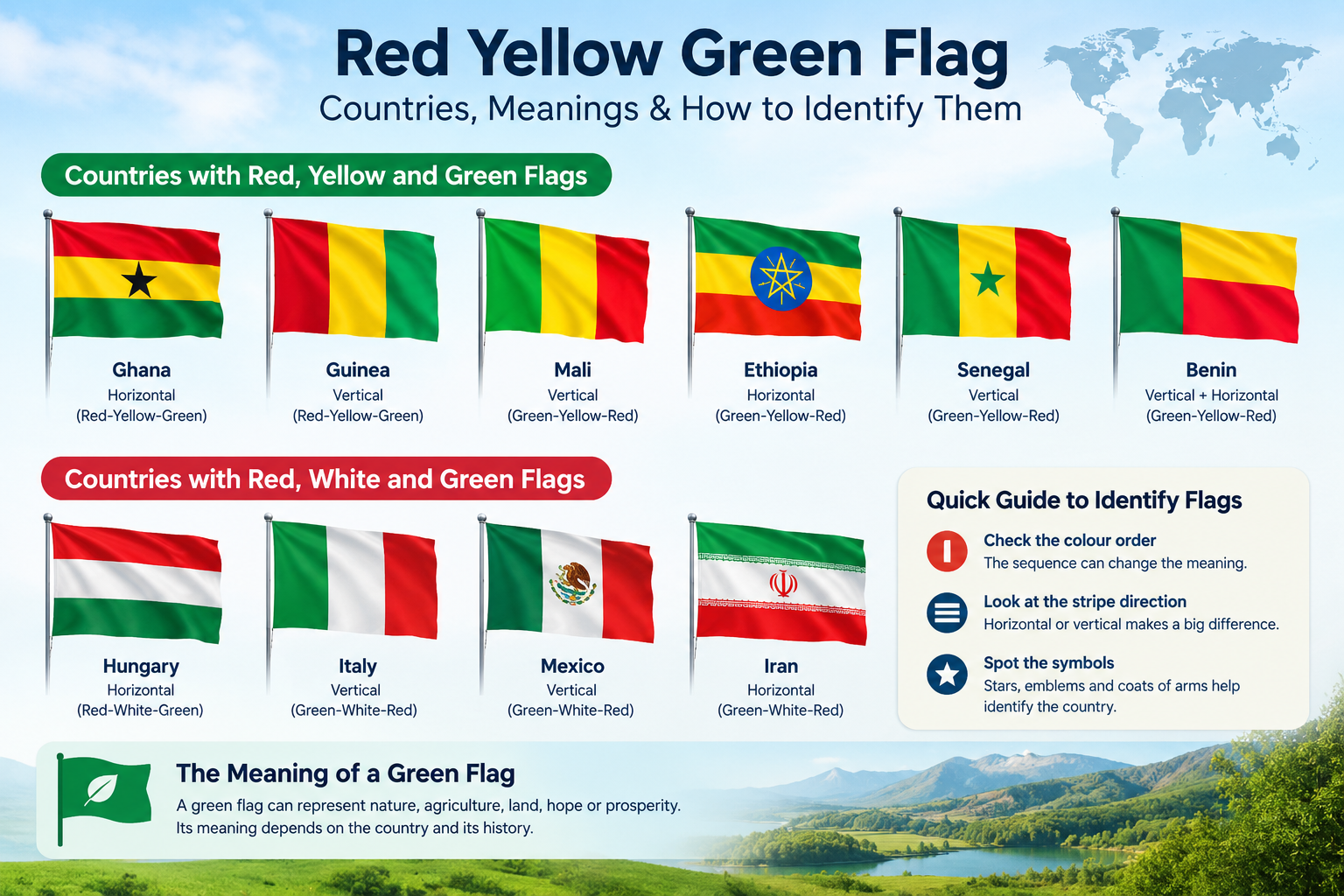

Flags use colour, shape, and symbols to represent countries, cultures, and history. However, several national flags share similar colours. That can make identification difficult.
The phrase red yellow green flag can describe several different national flags. The order of the colours is important. Symbols and stripe patterns also help identify the correct country.
This guide explains the main flags associated with red, yellow, and green. It also covers similar flags that include red, white, and green.
What Does the Red Yellow Green Flag Represent?
There is no single national flag officially known simply as the red yellow green flag. Several countries use these three colours in their national flags.
The colours are especially common among African nations. They often reflect historical, cultural, or political ideas. However, their meanings differ from one country to another.
For example, Ghana has a red, yellow, and green horizontal design with a black star. Guinea uses red, yellow, and green vertical stripes. Mali also uses these colours, but in a different order.
Therefore, knowing the colour order alone may not always be enough. You should also check the stripe direction and any symbols.
Ghana Flag: Red, Yellow and Green
The flag of Ghana is one of the best-known examples of a red yellow green flag.
Its design has three horizontal stripes. Red appears at the top, yellow sits in the middle, and green appears at the bottom. A black five-pointed star is placed in the centre of the yellow stripe.
The red colour represents the blood shed during the struggle for independence. Yellow represents the country’s mineral wealth. Green represents the country’s forests and natural resources.
The black star has a separate historical meaning. It is associated with African freedom and the emancipation of Black people.
Ghana’s flag is therefore easy to recognise when you remember its horizontal stripes and central black star.
Guinea Flag: Red, Yellow and Green
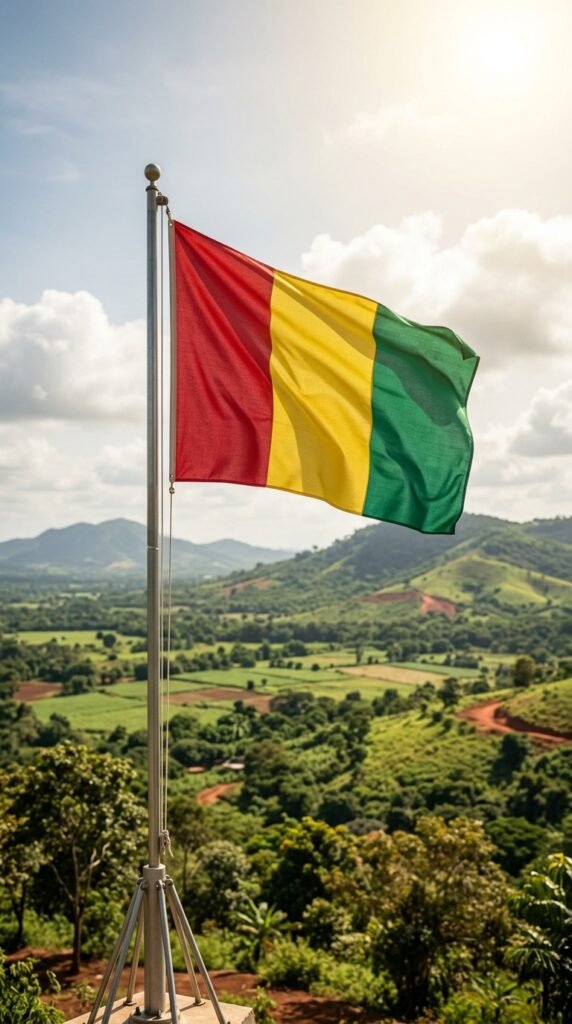
Guinea also uses red, yellow, and green. However, its design is different from Ghana’s flag.
The Guinea flag has three vertical stripes. Red is closest to the flagpole, yellow is in the centre, and green is on the outer side.
The colours have important national meanings. Red is linked with sacrifice and the struggle for independence. Yellow represents the sun and the country’s resources. Green reflects agriculture and the natural landscape.
The vertical layout is the key difference. If you see red, yellow, and green arranged vertically, Guinea may be the country you are looking for.
Mali Flag: Similar Colours, Different Order
Mali has the same three main colours but uses them in a different sequence.
Its flag contains three vertical stripes. Green appears next to the flagpole, followed by yellow and then red.
This makes Mali easy to confuse with Guinea. Both flags use vertical green, yellow, and red family colours. The difference comes from the order.
Remembering the stripe sequence can help you identify the flag correctly.
Other Flags With Red, Yellow and Green
Several other countries use combinations of red, yellow, and green. Ethiopia is an important example.
The Ethiopian flag has horizontal green, yellow, and red stripes. A blue disc with a yellow star and rays appears in the centre of the modern national flag.
Senegal also uses green, yellow, and red. Its stripes run vertically, with green at the hoist, yellow in the centre, and red at the fly. A green star sits in the middle of the yellow stripe.
Benin uses green, yellow, and red as well. Its design includes a vertical green section at the hoist and two horizontal sections in yellow and red.
These examples show why the phrase red yellow green flag can refer to more than one country.
Why Are Red, Yellow and Green Common on African Flags?
Red, yellow, and green appear together on many African national flags. Their popularity has historical roots.
The colours are strongly connected with Ethiopia, one of Africa’s oldest independent states. During the period when many African countries gained independence, these colours became associated with African identity and independence.
The combination is sometimes called the Pan-African colour scheme. However, individual countries give their colours their own meanings.
That distinction matters. A colour may represent similar ideas across several flags, but it does not always have exactly the same official meaning.
Red White Green Flag: Which Countries Use These Colours?
The red white green flag description also applies to several national flags. Hungary is one well-known example.
Hungary’s flag has three horizontal stripes. Red is at the top, white is in the middle, and green is at the bottom.
The colours have historical and national associations. Red has been connected with strength and sacrifice. White represents faith and freedom in traditional interpretations. Green is associated with hope and the country’s land.
Italy is another familiar example involving red, white, and green. Its flag has three vertical stripes, with green at the hoist, white in the centre, and red at the fly.
Mexico also uses green, white, and red vertical stripes. Its central coat of arms makes it easy to distinguish from Italy.
Iran uses green, white, and red too. Its flag contains additional symbols and inscriptions, making its design distinct.
Red Yellow Green Flag vs Red White Green Flag
The biggest difference between these flag groups is the colour combination.
A red yellow green flag contains yellow instead of white. A red white green flag contains white instead of yellow. However, several countries use both colour families in different designs.
The arrangement also matters. Horizontal and vertical stripes can quickly narrow down the possibilities.
Symbols provide another useful clue. Stars, coats of arms, and other national emblems can make a flag much easier to identify.
How to Identify a Green Flag
A green flag can mean many things. Green is one of the most common colours used in national flags.
Green often represents nature, agriculture, land, hope, or prosperity. Yet its meaning depends on the country and its history.
If most of a flag appears green, look for other colours or symbols. A small emblem can provide an important identification clue.
For example, a flag may appear mostly green from a distance but contain yellow, red, white, or another colour in a specific pattern.
Why Flag Colour Order Matters
Colour order is one of the fastest ways to distinguish similar national flags.
Consider Guinea and Mali. Both use three vertical stripes and share the same three colours. Their main difference is the order of those stripes.
Similarly, Ghana and Ethiopia both use red, yellow, and green. Their stripe arrangements and symbols help distinguish them.
For this reason, do not identify a national flag from colours alone. Check the direction, order, proportions, and symbols.
Common Confusion With Red Yellow Green Flags
People often confuse African flags because many share similar colours. This is particularly common with Ghana, Guinea, Mali, Senegal, Ethiopia, and Benin.
The easiest solution is to examine the flag systematically. First, check whether the stripes are horizontal or vertical.
Next, check the colour order. Finally, look for a star, emblem, or other central symbol.
This simple approach can prevent many identification mistakes.
Conclusion
The term red yellow green flag does not identify just one country. Ghana, Guinea, Mali, Ethiopia, Senegal, and Benin all use these colours in different arrangements.
The stripe direction, colour order, and symbols are important clues. They help distinguish flags that may look similar at first glance.
A red white green flag can also refer to several countries, including Hungary, Italy, Mexico, and Iran. Meanwhile, a green flag may describe many different national designs.
When identifying any flag, look beyond its colours. The complete pattern usually provides the clearest answer.
FAQs
What country has a red yellow green flag?
Several countries use red, yellow, and green. Ghana, Guinea, Mali, Ethiopia, Senegal, and Benin are notable examples. Their stripe patterns and colour orders differ.
What does the Ghana flag look like?
Ghana’s flag has three horizontal stripes. They are red at the top, yellow in the middle, and green at the bottom. A black star appears in the centre.
Which country has a red, yellow and green vertical flag?
Guinea has vertical red, yellow, and green stripes. Mali also has three vertical stripes, but its colour order is green, yellow, and red.
Which country has a green yellow red flag?
Several countries use green, yellow, and red. Mali and Senegal are notable examples, although their layouts and stripe directions differ.
What is the red white green flag?
Several national flags use red, white, and green. Hungary, Italy, Mexico, and Iran are well-known examples, each with a different design.
What does a green flag mean?
A green flag can have different meanings depending on its context. In national flags, it may represent nature, agriculture, land, hope, or prosperity.
For more updates visit: RANKIVO