



The words sociopath and psychopath are often confused. Many people think they mean the same thing. They do not always mean the same thing.
Both terms relate to behaviour, feelings, and social rules. They can also relate to a lack of concern for other people.
Still, neither word is a formal diagnosis by itself. Doctors and mental health experts use other terms when they assess a person.
So, what is the difference between a sociopath and a psychopath? Let’s look at the main points in simple terms.
What Is a Sociopath?
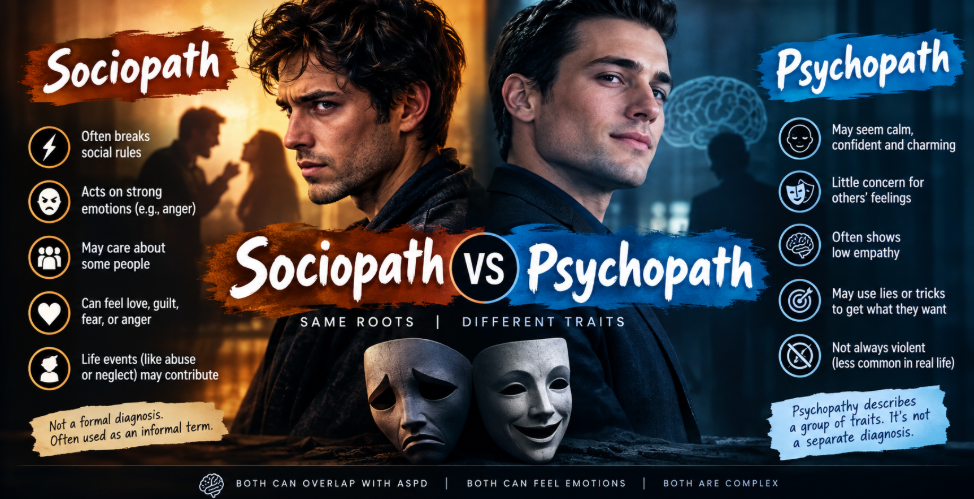
“Sociopath” is not a formal medical term. People often use it to describe someone who often breaks social rules.
A person called a sociopath may lie or cheat. They may also act without thinking about the results.
Some may have trouble keeping close relationships. They may get angry very quickly or act without much thought.
A sociopath may still care about some people. They may feel love, anger, guilt, or fear.
Life events may also play a part. Abuse, neglect, and a hard childhood can affect how some people behave later in life.
However, a hard childhood does not make someone a sociopath. Most people who face hard times do not develop these traits.
What Is a Psychopath?
Psychopathy is a term used in psychology. It describes a group of traits linked to emotions and behaviour.
A person with strong psychopathic traits may seem calm and confident. They may also seem friendly or charming.
At the same time, they may have little concern for other people’s feelings. Some may use lies or tricks to get what they want.
Low empathy can also be a part of psychopathy. The person may know that someone is hurt but may not feel much concern.
Many films show psychopaths as violent killers. That picture is too simple.
A person with psychopathic traits is not always violent. Real life is much more complex than what we see on TV.
Sociopath vs Psychopath: What Is the Difference?
The main difference often involves emotions and behaviour.
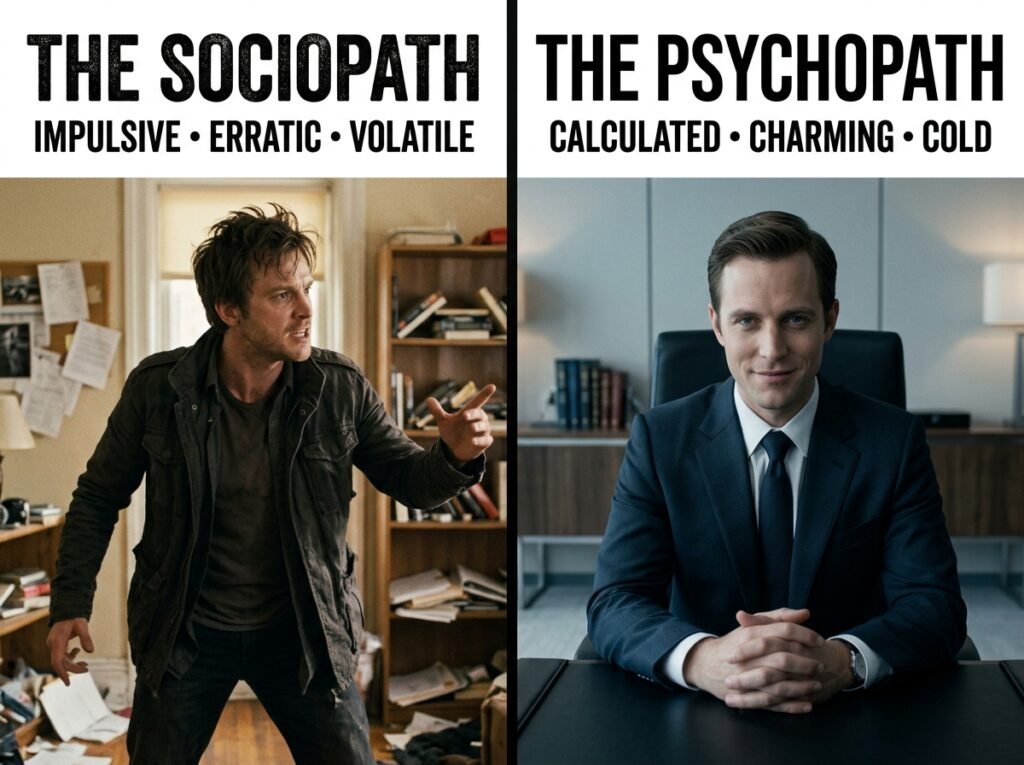
A sociopath may act on strong feelings. Anger can lead to sudden or risky actions.
A person with strong psychopathic traits may seem more calm. They may think before they act.
Relationships can also be different. A sociopath may care about a few people and form strong bonds with them.
A person with strong psychopathic traits may find deep emotional bonds harder.
These are only general differences. People are not always easy to place into one group.
Empathy and Emotions
Empathy means understanding how another person feels. It can also mean sharing or caring about those feelings.
This is an important part of the sociopath vs psychopath topic.
A person may understand that someone is sad. However, they may not feel the same sadness.
People with strong psychopathic traits may show this pattern. They may understand feelings without showing much care.
Someone described as a sociopath may show stronger emotions. Anger and frustration can have a strong effect on their actions.
Not everyone who seems cold has low empathy. One action cannot tell you what a person is really like.
Sociopath vs Psychopath and ASPD
Antisocial personality disorder is a real mental health condition. It is often called ASPD for short.
ASPD involves a long-term pattern of ignoring rules and other people’s rights.
A doctor does not diagnose ASPD after seeing one bad action. They look at a person’s behaviour over time.
Psychopathy and ASPD share some traits. However, they are not the same thing.
Someone with ASPD is not always described as a psychopath. A few psychopathic traits also do not prove that someone has ASPD.
This is why online labels can be misleading.
Are Psychopaths More Dangerous?
Not always.
A psychopath is not automatically violent. A sociopath is not automatically violent either.
Films often connect psychopathy with murder and crime. This can give people the wrong idea.
Many things can affect a person’s actions. These include their personality, life events, self-control, and social setting.
You should not label someone after seeing one or two bad actions. Lying or showing little emotion does not prove that someone is a psychopath.
A proper assessment needs much more information.
Can Sociopaths and Psychopaths Feel Emotions?
Yes. Neither term means that a person has no feelings.
A person described as a sociopath may feel anger, fear, love, or guilt. Strong feelings may sometimes affect their actions.
Psychopathic traits are often linked with weaker emotional responses. Low emotional empathy may also occur.
Even then, people are different. Two people with similar traits may not behave in the same way.
One action can never explain a person’s whole personality.
What Causes These Traits?
There is no single cause.
Many things may affect a person’s behaviour. Genes can play a role. So can childhood, family life, and the social world around a person.
A hard childhood may affect some people. Abuse and neglect can also increase the risk of later problems.
But there is no simple cause and effect. A person can have a hard childhood and never develop these traits.
This is why experts look at a person’s full history. They do not rely on one event.
Common Myths About Sociopaths and Psychopaths
One common myth is that all psychopaths are violent. This is not true.
Another myth says that you can spot a psychopath by their face. There is no special look that proves someone has psychopathic traits.
Some people also call anyone who lies a sociopath. That is not correct.
People can lie for many reasons. They can also act selfishly from time to time.
One bad choice does not mean someone has a mental health condition.
These terms describe complex patterns. They should not be used as simple labels for people we dislike.
When Should You Get Help?
You do not need to know if someone is a sociopath or psychopath before asking for help.
If someone’s actions hurt you, focus on your safety. Talk to someone you trust if you feel worried.
A mental health professional can assess serious behaviour and offer advice.
Do not try to diagnose someone yourself. Calling a person a psychopath can also make a difficult situation worse.
If you feel unsafe, seek help from a trusted person or a suitable professional.
Conclusion
The difference between sociopath vs psychopath is not as simple as films make it seem.
“Sociopath” is an informal term. It is often used for people who show repeated antisocial behaviour.
Psychopathy describes a group of traits. These can include low empathy, shallow emotions, and little remorse.
Both ideas can overlap with antisocial personality disorder. However, they are not the same thing.
Most importantly, you should not diagnose someone from an online article. A trained professional needs to look at the person’s history and behaviour.
FAQs
Is a sociopath the same as a psychopath?
No. The two terms are related, but they are not the same. Sociopath is an informal term, while psychopathy describes a group of traits.
Which is worse, a sociopath or psychopath?
Neither one is always worse. A person’s actions matter more than a label.
Can a psychopath love someone?
Yes, a person with psychopathic traits can have relationships. However, they may experience emotions in a different way.
Can a sociopath feel guilt?
Yes. A person described as a sociopath may feel guilt. They may still repeat harmful actions.
Are sociopaths more emotional than psychopaths?
Sociopathic behaviour is often linked with stronger emotions. Psychopathic traits are more often linked with weaker emotional responses.
Is psychopathy a mental illness?
Psychopathy is not a separate diagnosis in standard clinical systems. It is mainly used as a term in psychology and research.
For more updates visit: RANKIVO