


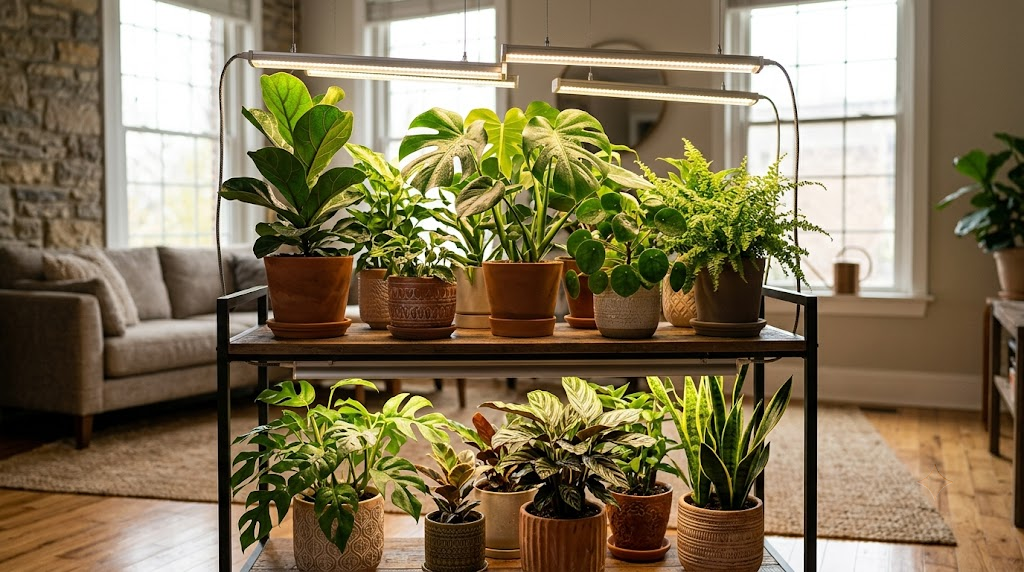

Most homes — even ones with big windows — don’t get anywhere near the light intensity plants need to actually thrive, especially from October through February. That’s where grow lights come in. But walk into the search results for “best grow lights for indoor plants” and you’ll find a mess of confusing specs, wattage claims that don’t mean much, and lists that all recommend the same five products.
This guide cuts through that. You’ll learn what actually matters when buying a grow light, which types are worth your money, how to size one for your space, and which mistakes waste the most electricity (and kill the most plants).
Do Indoor Plants Really Need Grow Lights?
Not always — but more often than people think.
Natural sunlight loses a huge amount of intensity once it passes through glass and travels a few feet into a room. A spot that looks “bright” to your eyes can still be too dim for a plant that evolved under open sky. Signs your plant needs supplemental light include:
- Leggy, stretched-out stems reaching toward the window
- Small, pale, or slow-growing new leaves
- A plant that hasn’t flowered in over a year
- Leaf drop during winter months
If you’re seeing any of these, a grow light isn’t a luxury — it’s a fix.
What Actually Matters When Choosing a Grow Light
Skip the marketing language for a second. These are the specs that determine whether a light works.
PAR and PPFD (Not Just Watts)
Wattage tells you how much electricity a bulb uses — not how much usable light it gives your plant. A 20-watt LED can outperform a 60-watt fluorescent tube. What you actually want to look at:
- PAR (Photosynthetically Active Radiation): the band of light wavelengths (roughly 400–700nm) that plants can use for photosynthesis.
- PPFD (Photosynthetic Photon Flux Density): how much of that usable light actually lands on the leaf surface, measured in µmol/m²/s. This is the number that tells you if a light is strong enough for your plant, at your distance.
As a rough guide:
| Plant Type | Recommended PPFD |
|---|---|
| Low-light houseplants (pothos, snake plant) | 50–150 |
| Medium-light foliage plants (monstera, ferns) | 150–250 |
| Flowering plants and herbs | 250–400 |
| Succulents and hard-to-flower plants | 400+ |
Full Spectrum vs. “Blurple” Lights
Older grow lights used only blue and red diodes, giving off that purple glow you may have seen in grow tents. Full-spectrum lights add green, yellow, and white wavelengths too. For houseplants specifically, full spectrum is the better pick — it supports photosynthesis across the whole plant, and it looks like normal light in your living room instead of a nightclub.
Color Temperature (Kelvin)
This measures how “warm” or “cool” the light looks, not how strong it is:
- 2700–3500K (warm white): cozier look, blends into home décor, slightly red-leaning spectrum.
- 5000–6500K (cool white/daylight): closer to natural daylight, often preferred for foliage growth.
Most modern full-spectrum LEDs blend both ranges, so this matters more for aesthetics than plant health.
Coverage Area and Distance
A light rated for a “4×4 grow tent” is not the right light for a single desk plant, and vice versa. Manufacturers usually list an effective coverage area at a specific mounting height — check that it matches your actual setup, not just the plant count on the box.
The Main Types of Grow Lights (And Who Each One Suits)
| Type | Best For | Pros | Cons |
|---|---|---|---|
| LED panels/bars | Shelves, plant corners, multiple plants | Efficient, long lifespan, low heat | Higher upfront cost |
| Clip-on grow lights | A single plant on a desk or shelf | Cheap, flexible, easy to reposition | Limited coverage area |
| Grow light bulbs (screw-in) | Existing lamps and fixtures | No new hardware needed | Coverage depends on the fixture |
| T5/T8 fluorescent tubes | Seed starting, plant shelving units | Even spread across a wide area | Bulkier, less efficient than LED |
| HID (HPS/MH) | Larger dedicated grow rooms | Very high output | Generates significant heat; overkill for most homes |
For the average home with a handful of houseplants, a full-spectrum LED — either a panel or a clip-on — covers almost every situation. Fluorescent tubes are still a reasonable, budget-friendly option for seed trays or plant shelves where even coverage across a wide, flat area matters more than intensity. HID lighting is rarely worth the heat and electricity cost unless you’re running a serious dedicated grow space.
How Many Hours a Day Should You Run a Grow Light?
Most houseplants do well with 12–16 hours of light per day, followed by a period of darkness — plants need that dark period to actually process the energy they’ve absorbed. Running lights 24/7 doesn’t speed up growth; it just wastes electricity and can stress some plants. A cheap outlet timer solves this instantly and is worth adding to any setup.
Placement Tips That Make a Bigger Difference Than the Light Itself
Even a good grow light underperforms if it’s positioned badly.
- Keep the light 6–12 inches from the foliage for most LED panels (check your specific model, since higher-output lights need more distance to avoid leaf burn).
- Angle the light so it reaches the whole canopy, not just the top leaves.
- Rotate the plant every week or two for even growth on all sides.
- Watch the leaves for the first week — bleached or curling leaves usually mean the light is too close or too intense for that plant.
A Realistic Look at Cost vs. Benefit
Grow lights range from around $15 for a basic screw-in bulb to several hundred dollars for high-output panels built for dedicated grow tents. For most houseplant owners, that expensive end of the market is unnecessary. A quality full-spectrum LED bulb or small panel in the $20–$60 range is genuinely enough to keep the average houseplant collection healthy through a dark winter. Save the higher-end panels for situations where you’re growing herbs, vegetables, or flowering plants indoors year-round and need consistently high PPFD.
People can also read this: 15 Large Indoor Plants That Transform Any Room (2026 Guide)
It’s also worth being skeptical of any product page that leans heavily on buzzwords without giving you real PPFD or coverage numbers. If a listing only talks about wattage and “full spectrum” without a spec sheet, that’s usually a sign the marketing is doing more work than the light itself.
Final Thoughts
The best grow light for indoor plants isn’t the one with the flashiest description — it’s the one that matches your plant’s actual light needs, your space, and how much you’re willing to spend on electricity. Start by figuring out what your plant currently lacks (usually intensity, not color), then match that to a light with real PPFD numbers and a sensible coverage area. Get those two things right, and almost any decent full-spectrum LED will do the rest.
Frequently Asked Questions
Do grow lights actually work for houseplants, or is it a gimmick?
They genuinely work. Grow lights supply the specific wavelengths plants use for photosynthesis, which is especially useful in low-light rooms or during winter months when natural daylight hours drop.
Can I just use a regular LED bulb instead of a grow light?
A regular household LED can help a little, but most aren’t full spectrum and don’t produce enough usable light (PAR/PPFD) for plants that need more than ambient brightness. A dedicated grow light is a safer bet for anything beyond very low-light species.
How close should a grow light be to my plant?
Most LED grow lights work best positioned 6–12 inches above the foliage, but this varies by wattage and output — always check the manufacturer’s recommended distance to avoid leaf burn or insufficient light.
Is red and blue light enough, or do I need full spectrum?
Full spectrum is the better choice for most houseplants. Red and blue “blurple” lights support basic photosynthesis but leave out wavelengths that help lower leaves and overall plant health.
Will a grow light make my electricity bill spike?
LED grow lights are energy-efficient, and running one for 12–16 hours a day typically costs only a few dollars a month depending on wattage and local electricity rates. It’s a small cost compared to replacing plants that die from insufficient light.
How do I know if my plant needs a grow light at all?
Watch for legginess, small pale new leaves, slow growth, or leaf drop in winter. If your plant sits more than a few feet from a window or in a room with limited natural light, it likely needs supplemental lighting.
For more updates visit: HEALTH BLOOM