


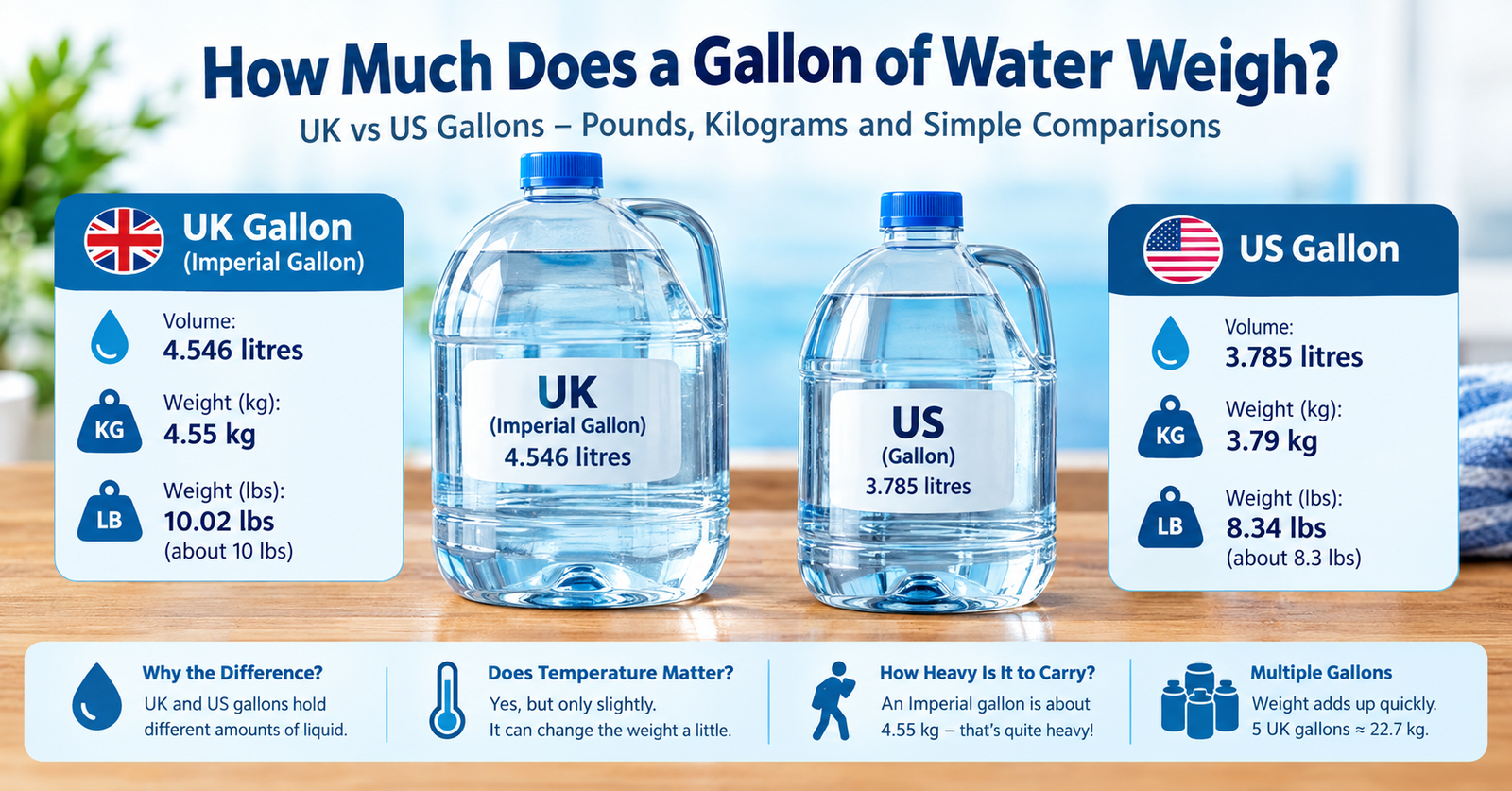

If you are asking how much does a gallon of water weigh, the answer depends on the type of gallon. The UK and US use different gallon measurements.
In the UK, an Imperial gallon of water weighs about 10 pounds. That is around 4.55 kilograms. A US gallon is smaller, so it weighs about 8.34 pounds, or 3.79 kilograms.
This difference matters when you convert measurements. It can also help when you carry, store, or transport water. Fortunately, the calculation is simple once you know which gallon you are using.
How Much Does a UK Gallon of Water Weigh?
In the UK, the term gallon usually means an Imperial gallon. One Imperial gallon contains about 4.546 litres.
Water weighs close to 1 kilogram per litre. Therefore, an Imperial gallon of water weighs about 4.55 kilograms. In pounds, that comes to roughly 10.02 pounds.
For everyday use, you can simply remember that a UK gallon of water weighs about 10 pounds. The exact figure can change slightly because water density changes with temperature.
Still, the difference is small for most household calculations. So, 10 pounds is a useful figure to keep in mind.
How Much Does a US Gallon of Water Weigh?
A US gallon is smaller than an Imperial gallon. It contains about 3.785 litres of water.
As a result, one US gallon weighs around 3.79 kilograms. In pounds, the weight is about 8.34 pounds.
That means a US gallon is roughly 1.68 pounds lighter than an Imperial gallon. The difference comes from the size of the gallon, not from the water itself.
Therefore, always check the measurement system when reading American information. This is especially useful for recipes, fitness advice, and product instructions.
Why Are UK and US Gallons Different?
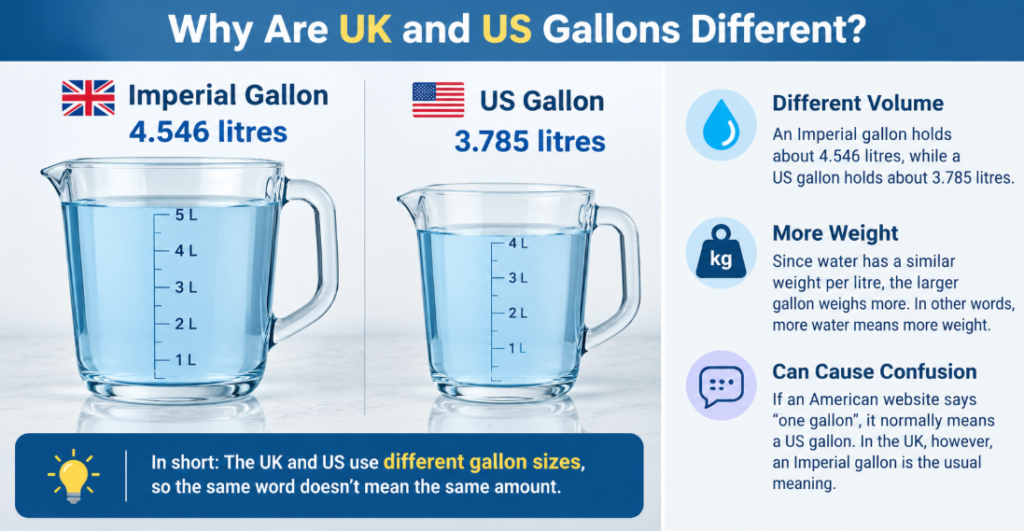
The main reason is the volume of each gallon. An Imperial gallon and a US gallon do not contain the same amount of liquid.
An Imperial gallon holds about 4.546 litres. By comparison, a US gallon holds about 3.785 litres.
Since water has a similar weight per litre, the larger gallon weighs more. In other words, more water means more weight.
This can cause confusion when converting measurements. If an American website says “one gallon”, it normally means a US gallon. In the UK, however, an Imperial gallon is the usual meaning.
How Much Does 1 Gallon of Water Weigh in Kilograms?
One Imperial gallon of water weighs approximately 4.55 kilograms. A US gallon weighs about 3.79 kilograms.
These figures are useful for many everyday calculations. For example, you may need them when choosing a water container or working out how much weight you can carry.
The calculation is based on the amount of water in each gallon. Since one litre of water weighs close to one kilogram, the litre measurement gives a simple estimate.
However, water density is not completely fixed. Temperature can cause small changes in the exact weight.
How Much Does 1 Gallon of Water Weigh in Pounds?
An Imperial gallon of water weighs around 10.02 pounds. For a quick estimate, you can round this to 10 pounds.
On the other hand, a US gallon weighs about 8.34 pounds. That is why the answer can look different on UK and US websites.
For everyday use, the rounded figures are usually enough. Use 10 pounds for a UK gallon and about 8.3 pounds for a US gallon.
This makes mental calculations much easier. It also helps you estimate the weight of larger water containers.
Does Water Temperature Affect Its Weight?
Water density changes when its temperature changes. Therefore, the exact weight of a measured volume can vary slightly.
For most everyday situations, this change is very small. You usually do not need to consider temperature when estimating the weight of a gallon of water.
For practical calculations, an Imperial gallon can be treated as about 10.02 pounds. Likewise, a US gallon can be treated as about 8.34 pounds.
More precise work may require a specific water temperature and density. This is more common in scientific and engineering applications.
How Heavy Is a Gallon of Water to Carry?
A gallon of water can feel quite heavy when you carry it. An Imperial gallon weighs around 4.55 kilograms.
That is similar to carrying a fairly heavy household item in one hand. The weight can become more noticeable when you carry the container for a long time.
A US gallon weighs less at around 3.79 kilograms. Even so, several gallons can quickly become difficult to move.
For example, two Imperial gallons weigh about 9.1 kilograms. Five gallons would weigh roughly 22.7 kilograms.
The container also adds extra weight. Therefore, the total weight will always be slightly higher than the water alone.
How Much Do Multiple Gallons of Water Weigh?
The weight increases directly as the number of gallons increases. You can estimate it by multiplying the number of gallons by the weight of one gallon.
For Imperial gallons, one gallon weighs about 4.55 kilograms. Two gallons weigh around 9.1 kilograms, while three gallons weigh about 13.6 kilograms.
Four Imperial gallons would weigh close to 18.2 kilograms. Five would reach about 22.7 kilograms.
The same method works for US gallons. At about 3.79 kilograms per gallon, two US gallons weigh around 7.57 kilograms.
How Do You Calculate the Weight of Water?
Calculating water weight is simple. First, identify whether the measurement uses Imperial or US gallons.
For Imperial gallons, multiply the number of gallons by about 4.546 kilograms. This gives you an approximate weight in kilograms.
For example, three Imperial gallons contain about 13.64 litres. Therefore, the water weighs roughly 13.64 kilograms.
For US gallons, use about 3.785 litres per gallon. So, three US gallons contain around 11.36 litres and weigh about 11.36 kilograms.
You can also convert the result into pounds. Simply use about 10.02 pounds per Imperial gallon or 8.34 pounds per US gallon.
Gallons of Water in Everyday Life
Knowing the weight of water can be useful in several situations. It can help you choose the right container or estimate how much water you can safely carry.
The information is also useful when planning storage. A large amount of water can place significant weight on shelves, tables, vehicles, or other surfaces.
For example, five Imperial gallons of water weigh about 22.7 kilograms. The container would make the total weight even higher.
As a result, large water containers should be handled with care. You should also consider the strength of the surface where the water will be stored.
What Is the Difference Between a Gallon and a Litre?
A gallon measures liquid volume, while a litre is a metric unit of volume. Both units are used to describe how much liquid a container holds.
One Imperial gallon equals about 4.546 litres. In comparison, one US gallon equals about 3.785 litres.
The litre is widely used in the UK and most other countries. Meanwhile, gallons remain common in the UK for some measurements and are widely used in the United States.
When converting between these units, always check which gallon is being used. Otherwise, the final calculation may be incorrect.
How Much Does 5 Gallons of Water Weigh?
Five Imperial gallons of water weigh about 22.73 kilograms. In pounds, that is roughly 50.1 pounds.
Five US gallons are lighter. They weigh around 18.93 kilograms, or about 41.7 pounds.
This difference is important when buying or moving large water containers. A container labelled as five gallons may therefore have a different weight depending on where it was measured.
Remember that these figures only describe the water. The bottle, tank, or other container adds its own weight.
How Much Does a Gallon of Water Weigh Compared With Other Liquids?
Water is often used as a simple reference because its density is close to 1 kilogram per litre. However, other liquids can have different densities.
For example, oil is generally less dense than water. Therefore, the same volume of oil usually weighs less.
Some liquids are denser than water and will weigh more for the same volume. As a result, you should not assume that every gallon of liquid weighs the same.
The exact weight depends on the liquid’s density. For accurate calculations, the type and temperature of the liquid should be considered.
Conclusion
So, how much does a gallon of water weigh? In the UK, one Imperial gallon of water weighs about 10.02 pounds, or 4.55 kilograms.
A US gallon is smaller and weighs about 8.34 pounds, or 3.79 kilograms. The difference exists because the two gallon measurements represent different volumes.
For a quick UK estimate, remember that one gallon of water weighs about 10 pounds. That simple figure is useful for everyday calculations, storage, transport, and water handling.
FAQs
How much does an Imperial gallon of water weigh?
An Imperial gallon of water weighs about 4.55 kilograms, or 10.02 pounds. For everyday calculations, you can round this to 10 pounds.
How much does a US gallon of water weigh?
A US gallon of water weighs about 3.79 kilograms, or 8.34 pounds. It is lighter because a US gallon contains less water than an Imperial gallon.
Does a gallon of water always weigh exactly 10 pounds?
No. An Imperial gallon is close to 10 pounds, but the exact weight can vary slightly. Water temperature affects its density, which can change the result.
How much does 5 gallons of water weigh?
Five Imperial gallons weigh about 22.73 kilograms, or 50.1 pounds. Five US gallons weigh about 18.93 kilograms, or 41.7 pounds.
How much does 2 gallons of water weigh?
Two Imperial gallons weigh around 9.09 kilograms, or 20.04 pounds. Two US gallons weigh about 7.57 kilograms, or 16.68 pounds.
Is a UK gallon bigger than a US gallon?
Yes. An Imperial gallon contains about 4.546 litres. A US gallon contains about 3.785 litres. Therefore, the UK gallon holds more water.
For more updates visit: RANKIVO