


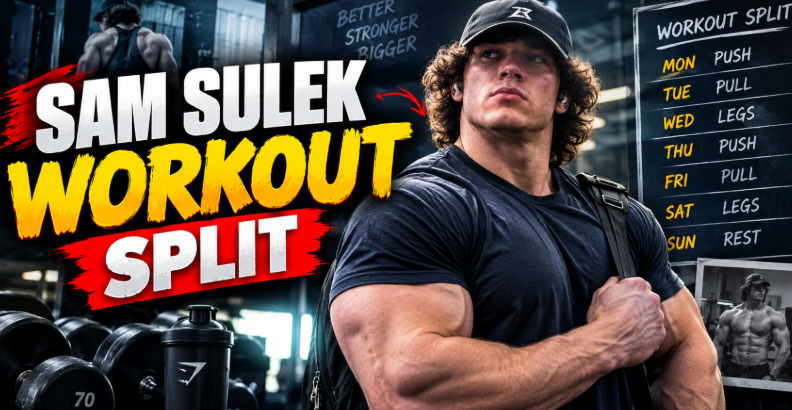

The Sam Sulek workout split is known for its straightforward bodybuilding structure, demanding workouts and focus on building muscle. Rather than following a complicated programme, Sam has commonly rotated through four main sessions: legs, chest and shoulders, back, and arms. He repeats the sequence and takes rest days when needed, instead of relying on a rigid Monday-to-Sunday schedule. However, his exercise choices and training methods can change, so this routine is best understood as a guide to his documented training style rather than a permanent, official programme.
For gym-goers who want bigger muscles, this approach offers a useful lesson in consistency, exercise selection and training effort. Still, copying a professional bodybuilder’s routine exactly may not suit everyone. Understanding the split, managing fatigue and adjusting training volume can help you build a more sustainable plan.
What Is the Sam Sulek Workout Split?
The Sam Sulek workout split is a body-part-focused bodybuilding routine. Each session concentrates on particular muscles, allowing the lifter to dedicate time to challenging compound exercises and targeted isolation movements.
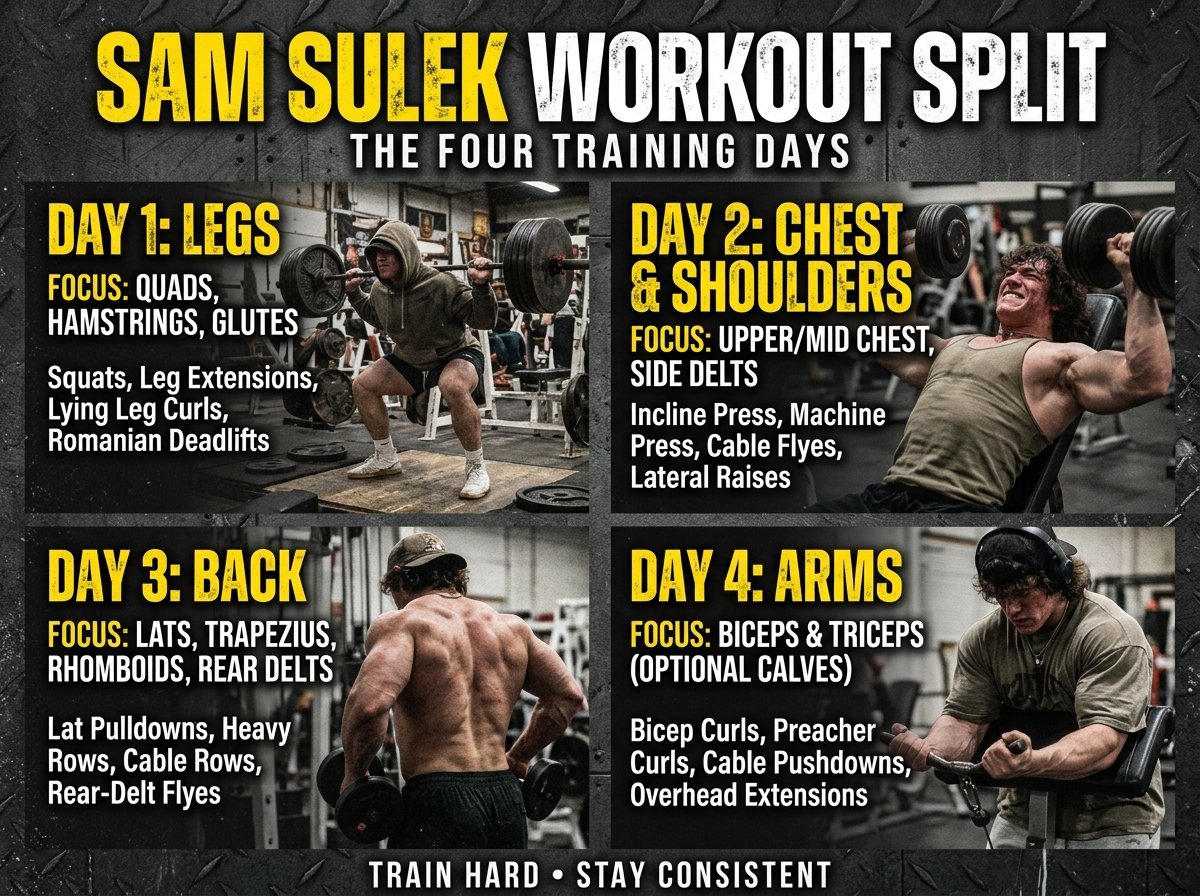
A commonly documented version follows four sessions in sequence. The first focuses on legs, the second combines chest and shoulders, the third trains the back, and the fourth targets the arms. Calves may receive additional attention during the rotation.
Unlike a conventional weekly plan, this approach does not necessarily assign every workout to a specific weekday. After completing the four sessions, the lifter returns to the beginning when recovery allows.
This flexibility is an important feature. Nevertheless, it does not mean that rest is unnecessary. Muscle growth depends on an appropriate balance between training stress, nutrition and recovery.
Sam Sulek Workout Split: The Four Training Days
Day 1: Legs
Leg day focuses on the quadriceps, hamstrings and glutes. Depending on the session, calves may also receive direct work.
A typical workout inspired by Sam’s training style might include squats, leg extensions, seated or lying leg curls, and a Romanian deadlift variation. These exercises cover different functions of the lower body, including knee extension, knee flexion and hip extension.
Squats and other compound movements challenge several muscles simultaneously. Leg extensions help target the quadriceps, while leg curls train the hamstrings more directly. Romanian deadlifts can strengthen the posterior chain when performed with controlled technique.
The goal is not to complete as many exercises as possible. Instead, choose movements you can perform safely, use a suitable range of motion and make each working set productive. Beginners should start with manageable loads before attempting very demanding sessions.
Day 2: Chest and Shoulders
The second session concentrates on chest development, with additional attention to the side deltoids and other shoulder muscles as appropriate.
Incline presses, machine chest presses and cable flyes are useful choices for a routine inspired by Sam’s approach. Incline pressing emphasises the upper portion of the chest, while fly variations train the chest through horizontal arm movement.
Dumbbell lateral raises or machine lateral raises can target the side deltoids. These muscles contribute to shoulder width and the rounded appearance associated with bodybuilding physiques.
Exercise order matters because fatigue accumulates during a workout. Many lifters perform their main presses first, then move to isolation exercises. However, the best order depends on individual priorities, equipment availability and comfort.
Keep pressing movements controlled, and avoid sacrificing technique simply to lift heavier weights. A challenging set should still allow you to maintain stable shoulders and consistent movement.
Day 3: Back
Back day targets the muscles responsible for pulling, shoulder movement and upper-body stability. It commonly includes the lats, trapezius, rhomboids and spinal erectors.
Lat pulldowns or pull-ups provide a vertical pulling movement. Rows complement them by training the back through horizontal pulling. Depending on your experience and equipment, you might use a chest-supported row, cable row or barbell row.
Rear-delt exercises can also complement back training. Reverse pec-deck movements and cable rear-delt flyes help target the rear shoulders, which contribute to balanced shoulder development.
Good technique matters more than momentum. Keep your torso controlled during rows, use a comfortable range of motion and avoid turning every repetition into a full-body movement.
The Sam Sulek workout split emphasises focused sessions rather than constantly changing the entire programme. You can apply the same principle by choosing a small group of effective exercises and tracking improvements over time.
Day 4: Arms
The fourth session focuses on the biceps and triceps. These muscles already contribute during back and chest exercises, but direct training can provide additional stimulus.
Biceps curls, preacher curls and cable curls are possible choices for biceps development. For triceps, consider cable pushdowns, overhead cable extensions or suitable machine exercises.
Different movements challenge the muscles from different positions. For example, overhead triceps extensions train the triceps with the arms raised, while pushdowns offer a different shoulder position. Using a few complementary exercises can therefore be more useful than repeating several nearly identical movements.
Pay attention to elbow comfort and control the lowering phase. Avoid swinging the weights or forcing painful repetitions. If your elbows remain sore or your performance declines, reduce the workload and review your technique.
Calves can be trained during this session or elsewhere in the rotation, depending on your priorities and recovery.
How Many Sets and Reps Should You Do?
There is no single set-and-rep prescription that applies to every version of the Sam Sulek workout split. His sessions have varied, and online routines often reconstruct his training from selected workout videos.
For a practical starting point, choose a few exercises per muscle group and perform around two to four working sets per exercise. Many exercises can be performed for approximately eight to fifteen repetitions, while some isolation movements work well with higher repetitions.
These ranges are guidelines, not strict rules. Muscle growth can occur across a broad range of repetition counts when sets provide sufficient effort and training volume is appropriate.
Warm-up sets should prepare you for working sets without creating excessive fatigue. They generally should not be counted as hard working sets when tracking your main training volume.
Most importantly, adjust your workload to your experience. A beginner may progress with fewer sets, while an experienced lifter might tolerate more. Adding exercises simply to imitate a professional’s workload can create unnecessary fatigue without improving results.
How Sam Sulek Approaches Training Intensity
One of the most recognisable features of Sam’s bodybuilding style is the emphasis on hard working sets. Rather than treating every set as an easy warm-up, his approach prioritises challenging the target muscle with focused effort.
Training close to muscular failure can help make sets demanding. However, failure means reaching the point where you cannot complete another repetition with the required technique. It should not become an excuse to lift with poor form.
For most gym-goers, leaving one to three repetitions in reserve is a practical starting point. This means finishing a set when you could still complete approximately one to three good repetitions. You can reserve occasional failure training for suitable isolation exercises once you understand your limits.
Heavy compound movements require extra care because fatigue can compromise technique. Squats and presses should never become uncontrolled attempts to match someone else’s performance.
Does the Sam Sulek Workout Split Include Rest Days?
Sam’s commonly documented rotating routine does not rely on a fixed weekly rest day. Instead, he has often described taking breaks when he feels he needs them. This differs from a conventional programme that assigns particular muscles to specific weekdays.
However, training without scheduled rest can make recovery difficult to manage, particularly for beginners. Poor sleep, persistent soreness, declining performance and unusual fatigue may indicate that your workload needs adjustment.
A more manageable option is to complete the four sessions across the week, with rest days between demanding workouts when necessary. For example, you could train legs on Monday, chest and shoulders on Tuesday, rest on Wednesday, train back on Thursday and arms on Friday. The weekend can provide additional recovery.
This schedule preserves the general structure without requiring four consecutive training days. Remember that the ideal arrangement depends on your experience, lifestyle and response to exercise.
Is the Sam Sulek Workout Split Good for Muscle Growth?
The split can support muscle growth when it provides enough challenging training, appropriate weekly volume and sufficient recovery. It also makes it easier to concentrate on particular muscle groups without rushing through a full-body workout.
Nevertheless, the split itself does not guarantee results. Resistance-training research supports several different programme structures, and individual variables such as training volume, effort and progression influence outcomes.
The American College of Sports Medicine’s 2026 review of resistance-training research found that resistance exercise improves muscle size and strength. It also highlighted the importance of individualising training rather than relying on one rigid prescription.
A body-part split may suit experienced lifters who enjoy focused sessions. Beginners, however, may find a full-body or upper/lower routine easier to manage because it can distribute training across the week more frequently.
Choose the programme you can follow consistently. A simpler routine that fits your schedule will often be more useful than an advanced split you cannot recover from.
How to Adapt the Routine for Your Fitness Level
Beginners
If you are new to resistance training, begin with fewer exercises and moderate effort. Learn the correct technique for basic movements before adding more sets or attempting failure training.
You could also train each major muscle group more frequently through a full-body programme. This approach provides regular practice and makes it easier to build a foundation of strength.
Intermediate Lifters
If you have several months of consistent training experience, the four-session rotation may be worth trying. Start with a manageable number of working sets and monitor your progress for several weeks.
Record your weights, repetitions and exercise variations. When you can complete the upper end of your target repetition range with good technique, consider increasing the load gradually.
Advanced Lifters
Experienced lifters may benefit from more specialised sessions and carefully managed training volume. However, more work is not automatically better. Additional sets can become less productive when fatigue interferes with performance and recovery.
Adjust the programme according to your results rather than copying another person’s workload. If strength declines repeatedly or soreness persists between sessions, reduce volume or add recovery time.
Nutrition and Recovery for Better Results
Training provides the stimulus for muscle growth, but nutrition and recovery help your body respond to that stimulus. Even a well-designed workout split may produce disappointing results if you consistently under-eat or sleep poorly.
Protein is important for muscle repair and growth. Include suitable protein sources such as eggs, dairy products, fish, lean meat, beans or other options that fit your diet. Total food intake should also support your activity level and goal, whether that is gaining muscle, maintaining weight or reducing body fat.
Carbohydrates can help fuel demanding workouts, while dietary fats support normal bodily functions. There is no need to copy an extreme bulking diet simply because a professional bodybuilder follows one.
Sleep also matters. Give yourself enough time to rest, and avoid repeatedly training through severe fatigue or pain. If you have an injury or a medical condition that affects exercise, seek advice from a qualified healthcare professional before starting an intense routine.
Conclusion
The Sam Sulek workout split is a bodybuilding-style routine built around four main sessions: legs, chest and shoulders, back, and arms. Its rotating structure, focused exercises and emphasis on training effort make it an interesting option for people who enjoy dedicated muscle-group workouts.
However, you do not need to copy every aspect of Sam’s training to make progress. Choose appropriate exercises, maintain good technique, increase your workload gradually and take recovery seriously. Most importantly, adapt the routine to your experience and schedule.
Consistency matters more than imitating a professional bodybuilder. A programme that challenges you while allowing you to recover is a stronger foundation for long-term muscle growth.
FAQs
What is Sam Sulek’s workout split?
Sam Sulek has commonly followed a four-session rotation covering legs, chest and shoulders, back, and arms. He repeats the sequence rather than always following a fixed Monday-to-Sunday schedule.
How many days a week does Sam Sulek work out?
His training frequency can vary because his rotating approach does not depend on a strict weekly calendar. Some versions of his routine involve consecutive training days, with rest taken when needed. Your own schedule should reflect your recovery and experience.
Does Sam Sulek train every muscle group twice a week?
Not necessarily. The frequency depends on how quickly he completes his rotation and whether he takes rest days. You should calculate your own training frequency from your actual schedule rather than assume every muscle receives exactly two sessions each week.
Does the Sam Sulek workout split work for beginners?
Beginners can learn from its focused sessions, but copying an advanced bodybuilding routine may be unnecessarily demanding. Starting with fewer exercises, controlled technique and manageable training volume is generally more appropriate.
Does Sam Sulek train to failure?
His training style is associated with very hard working sets and frequent efforts close to or at muscular failure. However, not every lifter needs to reach failure on every set. Maintaining good technique and managing fatigue are important priorities.
Can I build muscle with the Sam Sulek workout split naturally?
Yes, a suitably adapted version can support natural muscle growth. Results depend on consistent resistance training, progressive overload, adequate nutrition and recovery. You do not need to copy a professional bodybuilder’s exact training volume or lifestyle to benefit from the general approach.
For more updates visit: RANKIVO